


Trump directs Navy to return to steam catapults on aircraft carriers
Trump directs Navy to return to steam catapults on aircraft carriers

Filip Timotija Fri, August 14, 2026 at 3:58 PM UTC
1.2K
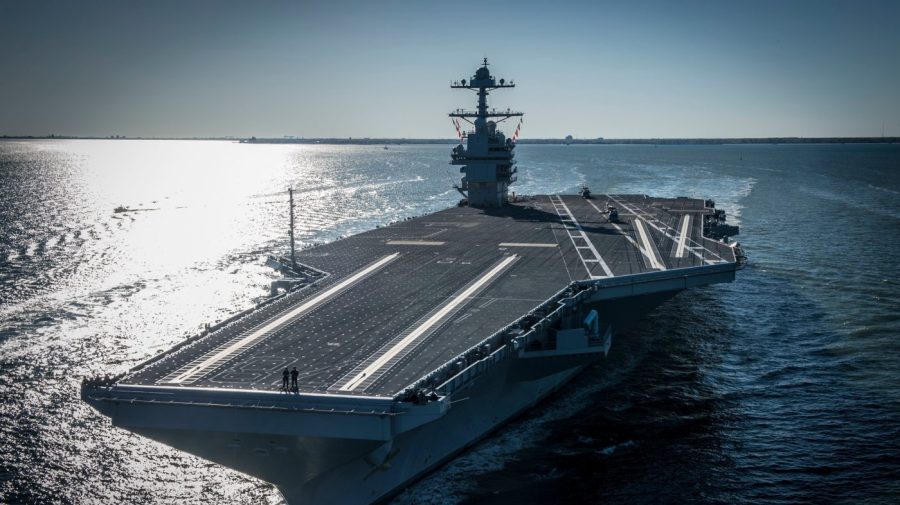
President Trump ordered the U.S. Navy on Thursday to remove the electromagnetic catapult system on aircraft carriers to launch fighter planes and revert back to using steam catapult systems, a move that officials and experts argue would raise costs in the process.
The president directed the service to equip Ford-class aircraft carriers, such as the USS Doris Miller currently being constructed, with steam-powered catapult and hydraulic systems instead of the newer Electromagnetic Aircraft Launch System (EMALS) and Advanced Weapons Elevators.
“The Department of War shall restore both capacity and competition to the maritime industrial base as it expands our naval force structure,” Trump said in the memo, using the administration’s preferred name for the Pentagon.
”It will use proven, reliable and affordable technologies and ship designs, as well as award contracts that enable purchases from foreign suppliers in the near term while simultaneously incentivizing investment in America’s shipbuilding industrial base, consistent with other major equipment purchases such as icebreakers,” the president said.
The USS Gerald R. Ford, the world’s largest aircraft carrier, currently uses EMALS, which Trump has criticized dating back to his first White House term as too complex and costly.
“Billions of dollars more they spent on electric catapults, and they’re not good,” the commander in chief said last month during a defense summit in Pennsylvania.
General Atomics, a California-based firm that secured a $1.2 billion contract to build the EMALS and Advanced Arresting Gear (AAG) for the USS Doris Miller, said the decision not to proceed with EMALS on the ship “warrants careful reconsideration.”
“With nearly 50 percent of production complete, changing course now would introduce significant cost, schedule and integration risks,” the company said in a statement Thursday.
“The decision will have broader implications for carrier readiness, national security and U.S. technological superiority, potentially creating opportunities for adversaries to close the capability gap,” the company stated. “It also comes at a time when strengthening the U.S. supplier industrial base is a national priority, making workforce stability, production capacity and the ability to sustain critical technologies more important than ever.”
Retired Rear Adm. Mark Montgomery, a senior fellow at the Foundation for Defense of Democracies, called the decision to revert to steam catapults “illogical, inefficient and a waste of money,” and he said EMALS “reduce wear and tear on aircraft by providing smoother acceleration.”
“They weigh a lot less, they use significantly less energy and water — which are in short supply on ships — require significantly less maintenance, and manpower,” Montgomery, a former commander of Carrier Strike Group 5 aboard the USS George Washington in Japan, told The Hill on Thursday.
Bryan Clark, a senior fellow and director of the Center for Defense Concepts and Technology at the Hudson Institute, said the memo is a “mixed bag,” noting that putting steam catapults and hydraulic arresting gear and elevators back onto carriers will make them “less capable and more expensive.”
“The Navy is saving about $100M a year on the Ford because it requires fewer people and less maintenance. Redesigning the carriers to replumb them for steam piping to the catapults will take multiple years and cost billions of dollars,” Clark, a sea warfare expert, said in an email to The Hill on Friday morning.
Steam catapults are no longer in production, and the Navy bought the last set 20 years ago, he said, adding that the service branch will need to “spend tens of millions and take years to stand up this production capacity again.”
The USS Gerald R. Ford, which cost more than $13 billion to build, experienced roadblocks during construction, including the elevators that bring up munitions to the flight deck and the arresting gear.
Advertisement
The nuclear-powered aircraft carrier is now in Hampton Roads, Va., for repairs following its 11-month deployment, which included the U.S. military operation to capture Venezuelan President Nicolás Maduro and participating in the war with Iran.
Earlier this year, the Navy highlighted the EMALS and AAG systems were designed to “deliver greater lethality and joint interoperability.”
“While the Navy is still analyzing the data, preliminary reports from the Sortie Generation Rate test program show that the flight deck design in conjunction with EMALS and AAG have contributed to an increased sortie generation rate compared to that of a Nimitz-class carrier,” the Navy said on Feb. 28.
The swap in fighter jet launch system was panned by some Senate Democrats, with one telling the president to “stick to what he knows best — ballrooms, bankruptcy and bulls‑‑‑.”
“I’ve launched off the front of aircraft carriers hundreds of times, have a Master’s degree in aeronautical engineering, and am a test pilot and even I wouldn’t suggest to the Navy how to engineer specific systems on its ships,” Sen. Mark Kelly (D-Ariz.), a former Navy pilot who sits on the Senate Armed Services Committee, said Thursday on the social platform X.
Trump’s Thursday memo also directs Defense Secretary Pete Hegseth to establish a new fifth naval shipyard to boost aircraft carrier and submarine repair capacity.
The U.S’s four other public shipyards, where the Navy typically overhauls nuclear-powered aircraft carriers and submarines, are in Hawaii, Washington, Virginia and Maine.
Clark, of the Hudson Institute, praised the push to open a fifth Naval shipyard.
“Using private capital to do it is a better use of private money than creating more new autonomous system companies,” he said
The memo tells the Pentagon to pursue more direct investments into the U.S. shipbuilding industrial base, allowing foreign shipbuilders to build up to two ships in their parent shipyards while training the U.S. workforce for the roles.
The memo also ordered Hegseth to establish a “Component Repair Center,” which would be able to store, repair and refurbish submarine parts and undertake a full review and “reorganization” of the Naval Sea Systems Command (NAVSEA), the largest of the U.S. Navy’s five system commands, to “address chronic challenges in American naval shipbuilding.”
Vice Adm. Jim Downey, commander of NAVSEA, retired last week, and now Rear Adm. Pete Small is serving on an interim basis.
Aug. 14 at 7:48 a.m. EDT.
Copyright 2026 Nexstar Media, Inc. All rights reserved. This material may not be published, broadcast, rewritten, or redistributed.
For the latest news, weather, sports, and streaming video, head to The Hill.
Source: “AOL Breaking”
